Executive Assistant Support for Nonprofit Leaders: What to Delegate and When It Makes Sense

Nonprofit leaders should delegate recurring administrative and coordination work that keeps meetings, relationships, follow-ups, and decisions moving, but does not require their direct involvement every time. That often includes calendar management, email support, board meeting preparation, donor follow-up, event coordination, document organization, and internal systems. When those responsibilities start pulling leaders away from mission-critical priorities, executive assistant support makes sense.
For many nonprofit leaders, that point arrives quietly.
It does not always look like a dramatic crisis. More often, it looks like an executive director answering emails after dinner, squeezing board prep between donor calls, rebuilding the same agenda for the third time, or realizing that an important follow-up never happened because the day got swallowed by other people’s priorities.
That is one of the hardest parts of nonprofit leadership: the work rarely stays in its lane.
A nonprofit leader may begin the week focused on strategy, fundraising, board engagement, or program growth. By Tuesday afternoon, they are coordinating schedules, looking for a document from last year’s meeting, responding to a stakeholder, approving event details, and trying to remember which donor needed a personal note before Friday.
Each of those responsibilities matters. But when every follow-up, reminder, scheduling decision, and next step depends on the executive director, the work starts to pile up around one person. That is usually when leaders feel the strain most, not because they cannot handle the work, but because too much of the organization’s momentum depends on their personal bandwidth.
The right executive assistant support for nonprofits leaders helps change that by bringing more consistency to the recurring details that keep meetings, relationships, and decisions moving forward.
In This Article:
“The proportion of nonprofit CEOs who report that their own burnout is very much a concern to them jumped to 46% in 2026, up from just under 30% in 2025.”
Why Does Executive Assistant Support Matter for Nonprofit Leaders?
Nonprofit leaders are often responsible for the long-range vision and the daily coordination required to keep people, priorities, and decisions aligned. That combination can get heavy fast.
The pressure is not just anecdotal. The Center for Effective Philanthropy found that nonprofit CEOs are increasingly concerned about their own burnout, with 46% saying it was “very much” a concern in 2026. Staffing strain adds another layer. Urban Institute research found that 72% of staffed nonprofits nationwide said employee vacancies negatively affected their ability to pursue their missions. For many executive directors, the issue is not simply having too much on the to-do list. It is trying to lead while the organization is operating under constant capacity pressure.
That pressure shows up in practical ways. A delayed response may affect a donor relationship. A disorganized board packet may frustrate volunteers who are giving their time. A missed follow-up may leave a staff member waiting, a partner unclear, or an opportunity sitting untouched.
Of course, not every task is urgent. Nonprofit work has a funny way of making everything feel urgent, even when some things can, in fact, wait until Thursday.
But leaders still need dependable support around the work that carries relationships, meetings, and decisions from one step to the next.
A strong executive assistant helps reduce the constant mental tracking that can wear leaders down. They help organize what needs a response, what needs to be prepared, what needs to be scheduled, and what cannot fall through the cracks.
That is often where the biggest relief comes from. Not just fewer tasks, but fewer loose ends.
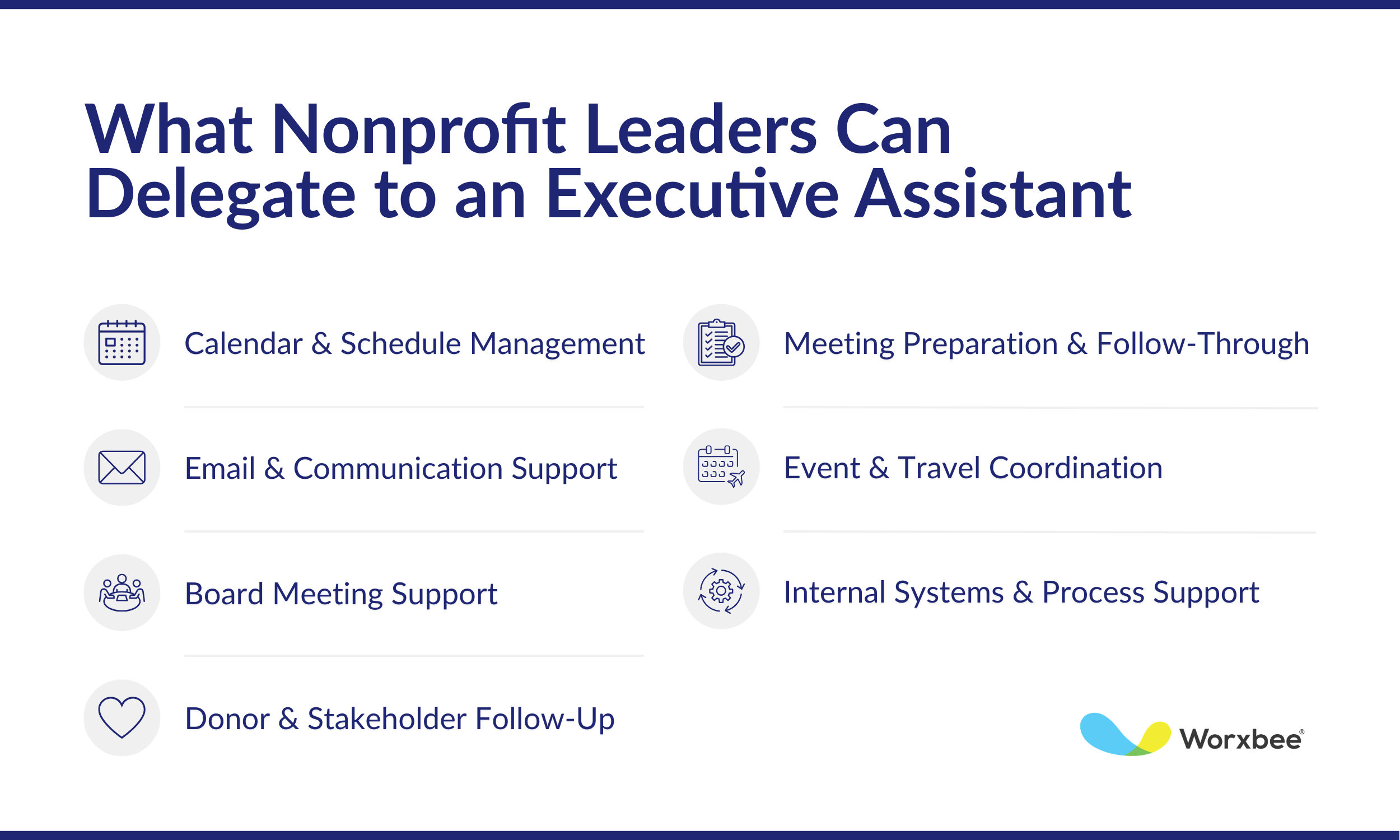
What Can Nonprofit Leaders Delegate to an Executive Assistant?
Nonprofit leaders can delegate work that is recurring, detail-heavy, coordination-focused, or important to relationships but does not require the leader’s direct judgment every time.
A simple way to think about it is this: if the task needs to happen consistently, but the executive director does not personally need to move every piece forward, it may be a strong fit for an executive assistant.
Some of the most valuable areas to delegate are the ones that sit closest to the leader’s time, communication, and follow-through.
Calendar and schedule management
A nonprofit leader’s calendar often tells the real story of their week. Not the polished version. The actual one.
It shows where time is going, which relationships need attention, which deadlines are approaching, and whether there is any room left for strategic work. When no one is actively managing that calendar, the day can quickly get filled by whoever asks first, follows up most often, or finds the last open slot.
An executive assistant can help by:
Scheduling meetings with board members, donors, staff, and community partners
Coordinating complex schedules across multiple people
Building in preparation time before important conversations
Protecting space for focused work
Rescheduling when priorities shift
Watching for meeting patterns that create unnecessary strain
This is often one of the easiest places to start because the relief is immediate. Instead of making dozens of small scheduling decisions throughout the week, the executive director has someone helping shape the calendar around what actually needs their attention.
That matters in a role where availability can quietly become the default. Without support, nonprofit leaders can end up accessible to everyone while having very little protected time for the work only they can do.
Email and communication support
For many nonprofit leaders, the inbox becomes the place where everything lands: donor notes, board questions, staff updates, meeting requests, vendor emails, community invitations, newsletters, and the never-ending “just checking in” messages.
Without a system, email can start to shape the day instead of supporting it.
An executive assistant can bring order to that flow by organizing messages, flagging what needs attention, drafting responses, and tracking follow-ups. Just as importantly, they can help the leader stay responsive without requiring them to live in their inbox all day.
That matters because nonprofit communication is deeply relational. A donor wants to feel appreciated. A board member may need context before making a decision. A staff member may be waiting for clarity. A community partner may simply need to know the relationship still matters.
Good communication support takes more than speed. It takes tone, judgment, consistency, and an understanding of which messages need a quick reply and which ones need a more thoughtful response.
With the right support, the executive director can stay connected to the people who matter most without personally managing every message, reminder, and follow-up from start to finish.
Board meeting support
Board support is one of the most natural areas for a nonprofit leader to delegate because much of the work is recurring, deadline-driven, and highly detail-oriented.
The executive director still leads the board relationship. They still own the strategy, the key conversations, and the substance of what needs to be discussed. But the process surrounding board meetings can often be supported by an executive assistant.
That may include:
Scheduling board and committee meetings
Sending calendar invites and reminders
Preparing agendas
Organizing board packets
Collecting updates or reports from staff
Sharing materials in advance
Tracking RSVPs
Capturing action items
Following up after meetings
Maintaining board documents and shared folders
The goal is not simply to “get the board packet done.” The goal is to make board communication feel organized, timely, and professional so the executive director can spend less time managing logistics and more time preparing for the conversation.
That matters because board members are often busy volunteers. When materials are clear, complete, and easy to access, they can show up better prepared. When follow-up is consistent, decisions are less likely to stall between meetings.
It also reduces the last-minute scramble that can happen before board meetings, when the executive director is trying to finalize materials, confirm attendance, and prepare for the actual discussion at the same time.
That kind of support creates a better experience for everyone involved.
Donor and stakeholder follow-up
Nonprofit leadership runs on relationships, and those relationships are often strengthened in the follow-up.
After a donor conversation, board discussion, community meeting, or fundraising event, there is usually something that needs to happen next. A thank-you note. A recap email. An impact update. A reminder to schedule the next conversation. None of these tasks may take hours on their own, but they do require attention and consistency.
When the executive director is pulled in too many directions, follow-up can become delayed, uneven, or dependent on what happens to stay top of mind.
An executive assistant can help keep relationship follow-up from becoming accidental or inconsistent.
For example, they might:
Track follow-ups after donor or stakeholder meetings
Draft thank-you notes or recap emails
Prepare background notes before calls
Coordinate donor meetings or lunches
Maintain contact details
Remind the leader of personal outreach opportunities
Help ensure important relationships receive consistent attention
This kind of support may look simple from the outside, however it’s not.
Donor trust and stakeholder confidence are built through repeated moments of reliability. A strong executive assistant helps make those moments more consistent, even when the leader’s schedule is full.
Meeting preparation and follow-through
Meetings are only useful if something happens because of them.
A nonprofit leader may leave a board meeting, donor call, staff check-in, or partner conversation with several next steps. One may require a quick email. Another may need careful handling. A third may depend on someone else taking action before anything can move forward. Without a clear system, those next steps can scatter quickly.
An executive assistant can help create structure before and after meetings by preparing agendas, gathering background materials, sending pre-reads, capturing notes, tracking decisions, and following up on action items.
This support is especially valuable because so much nonprofit work happens through conversation. A donor meeting can lead to a stewardship opportunity. A staff check-in can uncover a process issue. A partner call can open the door to a new collaboration.
The conversation is only the beginning. Follow-through is what turns it into progress.
Event and travel coordination
Many nonprofits have busy seasons where events, conferences, donor meetings, community gatherings, or board retreats take up a significant amount of leadership time.
Even when an event manager or development team is involved, the executive director often has their own layer of logistics to manage. They may need briefing notes, donor meeting schedules, travel details, speaking materials, transportation plans, or post-event follow-up reminders.
An executive assistant can help coordinate:
Travel arrangements
Event schedules
Speaking notes and materials
Donor or partner meetings around events
Registration details
Hotel and transportation logistics
Briefing documents
Post-event follow-up
This helps the leader arrive prepared, stay focused while they are there, and follow through afterward without personally managing every moving piece.
The executive director may be fully capable of handling those logistics. But when their most important role at an event is building relationships, representing the organization, and staying present in the room, the coordination around that presence is usually worth delegating.
Internal systems and process support
Sometimes the biggest drain on a nonprofit leader’s time is not one major problem. It is the slow build-up of small inefficiencies.
A board packet process depends on memory instead of reminders. Donor follow-up gets tracked one way by the development team and another way by the executive director. Meeting notes live in too many places. Staff requests come through email, Slack, text, and quick side conversations, which means the executive director spends extra time piecing together what needs attention.
This is where an executive assistant can be especially useful.
They can help create simple systems that make recurring work easier, such as:
Shared folders for board materials
Templates for recurring emails
Task trackers for follow-up items
Calendar reminders for recurring deadlines
Meeting agenda templates
Document naming conventions
Simple workflows for recurring processes
The key word is simple.
Nonprofits do not need more complicated systems that no one has time to maintain. They need a usable structure that reduces friction, makes follow-through easier, and helps recurring work happen the same way each time without adding unnecessary layers.
“Many organizations need high-level administrative and executive support, but they may not have the budget, workload, or operational need for a full-time executive assistant. ”
When Does Executive Assistant Support Make Sense for a Nonprofit?
Executive assistant support makes sense when the nonprofit leader is spending too much time managing coordination, communication, scheduling, follow-up, or recurring administrative work at the expense of leadership priorities.
The signs are usually easy to recognize once you name them:
The executive director has become the default person for every next step
Board meeting preparation feels stressful every cycle
Donor follow-up is inconsistent or too dependent on memory
The inbox is shaping the day more than the leader is
Meetings happen, but action items do not move forward
Staff are waiting on small decisions, reminders, or scheduling details
The leader is working longer hours just to keep up with administrative work
That last point matters for nonprofits.
Many organizations need high-level administrative and executive support, but they may not have the budget, workload, or operational need for a full-time executive assistant. They may need steady support each month, especially around board meetings, donor communication, or leadership follow-through, but not 40 hours a week.
That is where fractional virtual executive assistant support can be a strong fit.
FREE RESOURCE
Is your nonprofit leader carrying too much?
Download The Nonprofit Leader Capacity Audit to identify what should stay with the leader, what can be delegated, and what can become a repeatable system.
“Fractional virtual executive assistant support makes sense when a nonprofit leader needs experienced, proactive support but does not need or cannot justify a full-time employee.”
When Does Fractional Virtual Executive Assistant Support Make Sense?
Fractional virtual executive assistant support makes sense when a nonprofit leader needs experienced, proactive support but does not need or cannot justify a full-time employee.
This model can be especially useful for nonprofits because needs often shift throughout the year. The workload may increase around board meeting cycles, fundraising campaigns, gala season, grant deadlines, strategic planning, budget planning, leadership transitions, or busy donor stewardship periods.
During other seasons, the support may settle into a steadier rhythm: calendar management, email organization, meeting follow-up, document management, and process improvement.
That flexibility matters.
A full-time hire may be the right choice for some nonprofits, especially if there is consistent daily work or the role needs to be onsite. But for many nonprofit leaders, fractional support offers a practical middle ground: experienced help without the cost, commitment, or management responsibility of adding a full-time role.
It also helps the executive director delegate at the right level.
Not just basic task help. Not another person who needs constant direction. But a skilled executive assistant who can learn the leader’s preferences, understand the organization’s priorities, and keep important work moving behind the scenes.
“The first few weeks do not need to be perfect. They need to be clear.”
What Should Nonprofit Leaders Delegate First?
Nonprofit leaders should start by delegating work that is recurring, visible, and easiest to transfer with a little context.
The best starting points are usually:
Calendar management
Inbox organization
Meeting preparation and follow-up
Board meeting coordination
Donor or stakeholder follow-up tracking
These areas create quick wins because they reduce daily interruptions and give the executive assistant a clear window into how the leader works. They also help the assistant learn the leader’s preferences, communication style, key relationships, recurring priorities, and the places where details tend to get stuck.
The first few weeks do not need to be perfect. They need to be clear.
A nonprofit leader can start by asking:
What meetings happen every month?
Which relationships need the most consistent attention?
What emails should always be flagged?
What follow-ups often get missed?
What work keeps getting pushed to nights or weekends?
Where does the executive director feel constantly behind?
Those answers usually point directly to the best delegation opportunities. From there, the executive assistant can begin taking ownership of the recurring details that create the most pressure and the most immediate relief.
“Nonprofit leaders need the right support around them so their time, attention, and energy can stay closer to the mission.”
Support That Creates Capacity
Executive assistant support for nonprofit leaders is not about making the leader less involved. It is about making their involvement more intentional.
When the executive director is the only person tracking follow-ups, coordinating schedules, preparing materials, organizing communication, and keeping recurring details in motion, too much depends on one person’s capacity. Over time, that creates avoidable pressure around work that could be shared.
The right executive assistant gives those recurring details a clearer place to live.
Board materials are prepared with less last-minute scrambling. Donor follow-up is tracked instead of relying on memory. Meetings have clearer next steps. The calendar becomes easier to manage with the organization’s actual priorities in mind. Email becomes less likely to pull the leader into constant reaction mode.
None of this replaces the human work of nonprofit leadership.
It supports the conditions that make that leadership more sustainable.
Because nonprofit leaders do not need more pressure to carry every detail themselves. They need the right support around them so their time, attention, and energy can stay closer to the mission.